
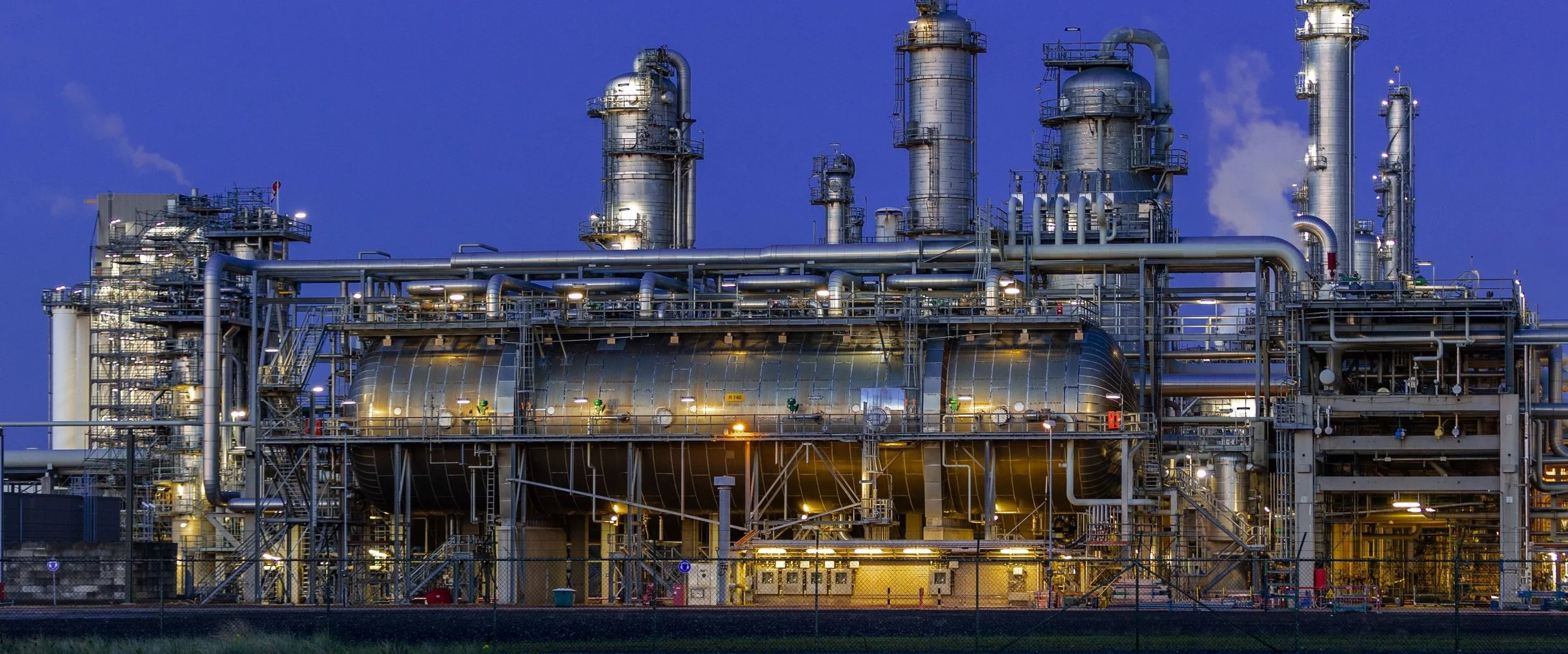
The production challenge
SAF is the destination; production is the bottleneck
If you produce or plan SAF, you will know the gap between ambition and output. In 2026 the world will make about 2.4 million tonnes of SAF, roughly 0.8% of the jet fuel airlines burn. Mandates ask for 6% in the EU and 10% in the UK by 2030, and far more by 2050.
One pathway carries the load
Almost all SAF today is HEFA, made from waste oils, fats and crop oils. It is the cheapest route to build, but the supply of waste lipids is finite, and crop oils carry higher lifecycle emissions.
The next pathways cost more
Alcohol-to-jet, gasification with Fischer–Tropsch and power-to-liquid widen the feedstock base, but each needs more capital per litre of capacity and more years to demonstrate at scale.
Volumes grow plant by plant
Each new plant must win funding, permits, feedstock contracts and offtake before it is built. Output follows a few years behind every decision.
~0.8%
of jet fuel was SAF in 2026 (IATA)
6% / 10%
EU and UK SAF mandates for 2030
Sources: IATA, December 2025 outlook and June 2026 update (2.4 Mt SAF, 0.8% of fuel); ReFuelEU Aviation; UK SAF Mandate.
Blending
Every litre of SAF still rides on fossil jet fuel
A synthetic blending component is not yet jet fuel. Under ASTM D7566 it must be blended with conventional jet fuel, at up to 50%, and the blend must contain at least 8% aromatics, which today come from the fossil side. Only then is it certified as Jet A or Jet A-1 and used like any other fuel.
Fossil jet sets the ceiling
Each tonne of SAF needs at least a tonne of conventional jet fuel to blend into. As refineries close or shift away from jet, the blending base and its quality matter more, not less.
Fossil jet sets the quality
Aromatics, sulphur and other trace components in the conventional share decide much of how the blend behaves: seal swell, density, soot and contrail formation.
100% SAF is still ahead
Engine and airframe makers are working towards certified 100% synthetic fuels, but until then, and for decades of existing fleets, blends are the rule.
What this means for you: for at least the next decade, most of the fuel in every aircraft will be conventional jet fuel, and every SAF blend will contain it. The composition of that fuel matters: it is half of every blend and all of the rest.
Sources: ASTM D7566 (blend limit up to 50%; minimum 8% aromatics in the blend); ASTM D1655 and DEF STAN 91-091 (Jet A / Jet A-1).
Capital and time
SAF plants are capital-intensive and slow to build
New SAF capacity takes years and large sums to reach the market. Published comparisons put the capital cost of a mature HEFA plant at a fraction of that of gasification or power-to-liquid plants, and first-of-a-kind plants cost several times more again.
Capital per litre
HEFA is the least capital-intensive route. Gasification with Fischer–Tropsch and power-to-liquid need roughly four to six times more capital per litre of capacity for a mature plant, and pioneer plants several times more again.
Years to output
Each step up in technology readiness takes two to three years. A gasification plant can take around five years from investment decision to operation. Germany’s largest planned e-kerosene plant (30,000 t a year) expects its decision in 2027 and operation in 2030.
Risk at every step
Feedstock contracts, power prices, permits and offtake all have to align before investors commit. Many announced projects never reach a final investment decision.
Where we come in
Fuel Signals works with the fuel you can make and buy now. We tune the composition of specification-compliant jet fuel, fossil, SAF or blend, towards the properties you care about, including molecular optimisation for advanced characteristics such as lower soot and contrail formation. It needs no new plant: it starts from refinery streams and blending choices you already control.
Sources: Boeing Australia, SAF Rules of Thumb (May 2026), capital cost per litre by pathway (±30%); IEA AMF Task 66 webinar (Van Dyk), TRL steps of 2–3 years and ~5 years from FID for gasification/FT; ingenieur.de, 29 Jan 2026 (Schwedt e-SAF plant: 37,000 t/yr, FID 2027, operation 2030).
Fuel Signals
A fuel tuned to your priorities
If your interest is a particular performance, from lower soot and contrail formation to cold-flow behaviour, viscosity or energy content, we tune a fuel's composition towards it, within the specification. What you receive is fully documented.
- Works within today's jet fuel specifications, for SAF and fossil jet fuel
- Specialist fuels outside the main standards can be explored on request
Your questions
Which fuel compositions meet my property targets, within the standard?
Which candidates should I send for testing first, and why?
Can I keep my target properties confidential when I commission work?
Where, and at what cost, could my preferred fuel be made at scale?
What you take away
- A ranked shortlist: the top recipes for each performance requirement, or combination of requirements.
- Predicted performance with error bands: and the trade-offs between properties.
- What to test first: with the validation status shown on every result.
- Fuel samples: production of the chosen recipes for lab testing or engine test beds, priced batch by batch.
- Making it at scale: a techno-economic report on where and how the fuel could be made, the economics, and the supply chain.
- Introductory Signal: an initial Signal on a defined question of your choosing, at our expense, so you can assess the standard of our work. See below.
If you work in an airframe or engine fuels team, produce SAF, refine, or make specialist fuels, these questions are likely to be yours.
Independent testing
Tested against your priorities
You decide which properties matter and how to weigh the trade-offs between them. Every recipe proposed to you is then tested against those priorities, by checks that are independent of how it was designed.
Separate benchmarks
Your recipes are tested against independently trained models built on published, trusted benchmark fuel data, entirely separate from the design work.
Replicable and measurable
Every test can be repeated, and every prediction comes with its certainty range.
Checked for bias
Where a recipe beats the benchmarks, the result is checked for bias before it reaches you.
Your targets stay yours
Because the shortlist is ready before physical testing, your target properties stay with you, away from test laboratories.
From screen to flight
Step 1
Predicted and benchmarked
The shortlist, its predicted performance and certainty bounds, against independent benchmarks.
Step 2
Lab and engine test bed
The leading recipes made and measured against matched comparator fuels.
Step 3
Flight testing
Validation in service conditions, with the results fed back into the next round of tuning.
Why you can rely on it
- Published engine and flight data show fuel composition changes soot emissions: hydrogen content, naphthalenes and sulphur all matter. Brem et al. 2015; Moore et al. 2015; Märkl et al. 2024
- Every result is labelled with its validation status; predictions stay hypotheses until tested.
- The methodology is being independently peer reviewed by Cranfield University, giving you independent scrutiny of the approach.
Introductory Signal
As an introduction to our work, we will prepare an initial Signal on a defined question of your choosing, at our expense. It sets out our view, the reasoning and evidence behind it, and a range of outcomes we see, in the most common form we deliver to any client.
It allows you, and those you report to, to assess the standard of our work against a decision that matters to you, before any mandate is agreed.
Provided under a mutual non-disclosure agreement; one per organisation. All rights reserved, including copyright, our discretion over engagements and the preservation of our independence.
Requests to action@circulairity.co.
Specification-compliant fuels, tuned to your priorities and independently tested