Contrail Research Programme
Cutting contrail warming at the fuel: a research programme
For physical validation of specification-compliant jet fuels, molecularly tuned at production, designed to cut contrail warming · Works for SAF and fossil jet fuel · Needs no new aircraft, engines, or airport infrastructure · © CirculAIRity Ltd 2026
Why contrails, and why fuel
The biggest single factor: Contrail cirrus is the largest single contributor to aviation's warming effect: 57% of its net effective radiative forcing in 2018 (Lee et al. 2021).
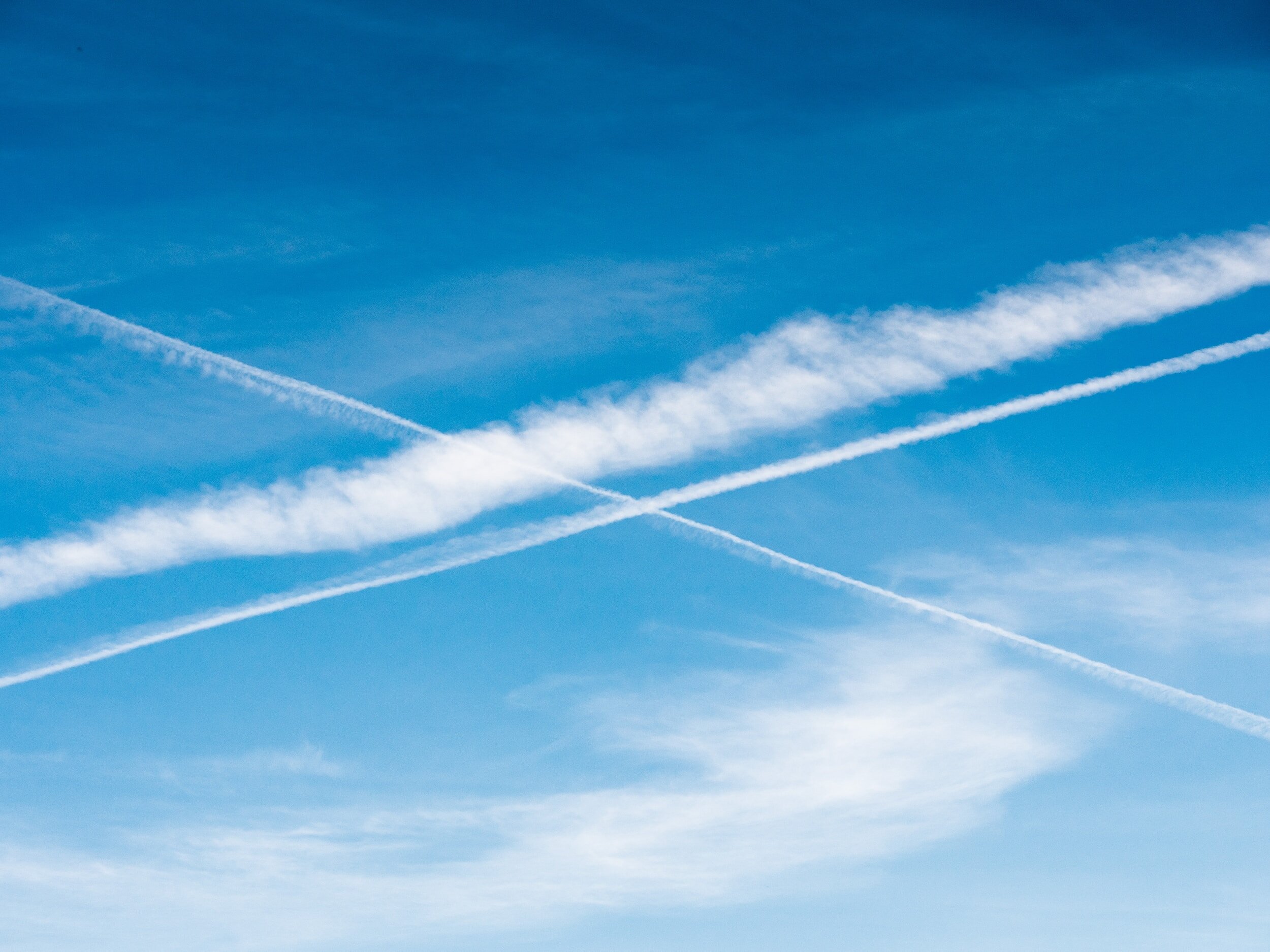
Jet fuel soot seeds the ice: Contrail ice forms mainly on engine soot. Fewer particles give fewer, larger crystals, and so thinner, shorter-lived contrails (Kärcher 2018; Burkhardt et al. 2018).
Concentrated in a few flights: 2% of flights caused 80% of contrail forcing in 2019 (Teoh et al. 2024).
Avoidance reaches few flights: Predicting contrail formation continues to improve but dynamically changing take-off times, altitudes, and flight paths remains a challenge (Gierens et al. 2020; EUROCONTROL MUAC 2024). The largest planned European avoidance programme would reach about 0.05% of annual flights (CirculAIRity calculation). A fuel lever acts on every flight an aircraft makes.
Policy is coming
Measurement has started. Since 1 January 2025, the non-CO2 effects of flights within EU ETS scope are monitored and reported (Directive (EU) 2023/958).
Proposals are due. The European Commission must report by 31 December 2027 and, where appropriate, propose measures to mitigate non-CO2 effects. In the UK, the Jet Zero Taskforce has set out a strategic framework for contrail mitigation.
A price follows measurement. Our central scenario sees the EU pricing non-CO2 warming around 2030–32 and the UK around 2033 (CirculAIRity scenario). Fuels proven before then will be ready when it lands.
How much can fuel do? The evidence
Fuel composition impacts contrail forcing: Cleaner-burning fuels cut soot and contrail ice by 50–70% (Voigt et al. 2021; Märkl et al. 2024).
The limits: At very low soot, volatile particles from sulphur and organics nucleate ice instead (Voigt et al. 2026). Modelling based on 100% SAF flights, indicate that the reduction in contrail warming is up to about 44% (Teoh et al. 2022). SAF blends partially provide this benefit by reducing aromatic content.
Targeted: Putting cleaner fuel on the right flights multiplies climate benefit by 9–15 times (Teoh et al. 2022).
CirculAIRity Fuel Tuning: We go further by tuning the whole fuel as one: Aiming for contrail benefit at speed, scale, and lower cost.
Why our programme
Integrating policy with specification: Our holistic fuel tuning is designed for emerging contrail policy, to today's specifications (ASTM D1655, DEF STAN 91-091).
One unit of warming: Results reported in tonnes of CO2-warming-equivalent (GWP*, declared 30-year period), with GWP100 alongside.
Independent scrutiny: Every claim carries an evidence grade. Our work is being peer reviewed by Cranfield University.
Led by a fuels subject matter expert: Alex Chikhani, CEO, a former RAF fuels specialist, and member of ASTM Committee D02's aviation fuels subcommittee (D02.J).
·Chemistry joined to economics: Our work optimises the commercial value of climate-tuned fuels.
How you can become involved
If our research touches your work or area of interest, we would be delighted to hear from you. We are particularly interested to hear from you, partners and fellow research sponsors around the following areas.
1. Engine test beds: Burn the candidate fuel against matched comparators for various flight profiles, to validate our expected combustion characteristics and emissions.
2. Independent atmospheric impact testing: Assess how readily the exhaust particles during various flight profiles form into ice, using an ice-nucleation chamber.
3. Into warming: Run the measured change through contrail models to give tonnes of warming avoided, route by route, then subsequent flight testing and validation.
The Upside Potential
-
a year: EU and UK contrail warming valued at today's EU ETS price, still unpriced
-
a year by 2050: contrail-abatement market, balanced policy (≈£90bn if strong)
-
a year by 2050: our revenue potential once validated (range £0.4–1.9bn)
Revenue from IP licensing, fuel staging, credits and OEM partnerships. (CirculAIRity figures; policy scenarios, not forecasts).
Get in touch to be part of our story:
Contact us for a 30 minute exploration call. Programme outline and terms under NDA.
Sponsors gain early access to data, a seat on the technical review group, the option to add your own reference fuel or test conditions, and acknowledgement in publications.
Research Sponsorship Enquiries
partner@circulairity.co